Bahecharlal Trikamji Patel (‘Vihari’)
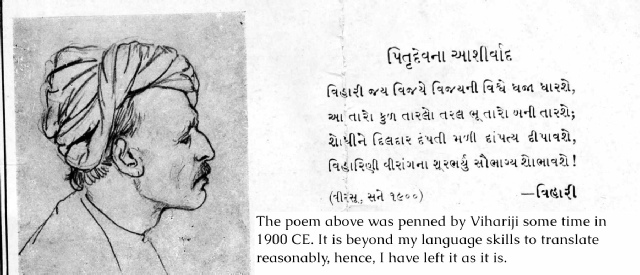
Bahecharlal, a man of indifferent fame, but blessed with high intelligence and quick grasp, known in Kathiavaad as ‘Viahri’ - the psedonym under which he wrote poems – was born in Sihor town in the Bhavanagar principality to Trikamji Purushottam and his wife Gangaabai on 22nd March 1866 AD, corresponding to Chaitra’s 6th declining lunar phase in Vikram Samvat 1922 in the Patidar clan.
Bahecharlal’s school education was split between 7 classes in the Gujarati system at a school in Sihore, and 6 more in the English system at a school in Rajkot. Onwards at a training college in Ahmedabad to study teaching – graduating at the top of his class with 80% marks – starting his employment career in the education department, and carrying on there till his retirement, holding responsibilities as headmaster of a regional school, as well as teacher at the Gondal Education Mandir.
He married Manibaai in Vikran Samvat 1941, ( 1984 AD). They had three sons, all of who graduated from Universities. Chandulal – the eldest – was the Education minister of Gondal state, while the other two, namely Jayantilal and the youngest Dhimatlal both practicied law.
His father Trikamji was steeped in social mores of the period, was fond of reading and a vedic scholar. He inculcated deep attachment to education and knowledge in his son. Subsequently, Bahecharlal had the opportunity at a young age to associate with well known scholars and litterateurs of that age like philosopher Navalrambhai, gujarati prosody master Ranachhodbhai Udayram, and scholars like Keshav Harshad Dhruv and Dahyabhai Dersari from who he absorbed values, culture and literary traditions of the highest order. Additionally, his self development led him to poet Narmad’s balads of courage and love, literary creations like “Hind Ane Britania” (Hind and the British Empire perhaps more appropriately the areas of British influences) authored by Ichchharam Suryaram Desai, the famous romantic historical “Sarasvatichandra” by Govardhanram Tripathi, Manilal Nabhubhai’s “Gulabsinh” etc. which influenced his development deeply guiding him to a literary orientation in life. He was also very well versed in Sanskrit, and had studied in detail Mahabharat, Bhagavat, Brahmasutra, Gita etc. in the original Sanskrit. His consequential association and spiritual debates with gurus’ like Shri Prakashanandji Maharaj and other such saintly personalities had given him very mature erudition.
His literary creations included commentaries on various scriptural books, besides poems in Sanskrit and Gujarati. He had a strong affinity for Vedant besides literature in general. His first creation “Veersinh Ane Premray” was an epic poem that was published in Vikram Samvat 1943 (1886 AD) at age 21. His well known creation is the poem “Viras” and he gained renown with his verse for verse translation of Kalidas’s epic “Meghdoot” into Gujarati. He also created a collection of poems called “Atmonnati” (self-progress) containing his various creations.
He had varied interests in life, and his sharp intellect enabled him to shine in various pursuits. His favourite subject – besides Sanskrit – was Mathematics, and he was quite a mathematician, with skills in business accounting. He could multitask 8 ways simultaneously. (Actually the word is “Ashtavadhaan”, a descriptive term in Gujarati meaning “someone paying attention to 8 matters at a time”, but the “8” is a customary number not a factual one.). He was also considered a handwriting expert, and called in to examine them. He was also well known as an astrologer; to the extent that he had predicted the exact date and time of his own departure from this life, and that had held absolutely accurate as he passed away in Gindal on Vikram Samvat 1993 in the month of kartik, on the 4th waxing lunar phase, corresponding to 22nd November 1937 AD.
Bahercharlal was a intensely committed nationalist, and wore Khadi (a type of handspun cloth promoted by Gandhiji as a protest against the mill spun cloth imposed on India by the British) all his life. His patriotic poems and couplets are were well known in his time. Besides his service to literature and education, he was perennially involved in community and nationalistic activities.
Here is a list of his literary creations:
# Title V.S. AD
1 Veersinh Ane Premraay 1943 1887
2 Panchdashi Bhashantar (translation of a Sanskrit book by this name that explained principles described in Vedant i.e. the Upnishad’s.) 1949 1893
3 Bhagavat Pushpanjali (a reverential translation of the Bhagavat – a puran scripture detailing Krishna’s times and life.) 1951 1893
4 Mahimnastotra Bhashantar (translation of a scriptural hymn in Sanskrit in praise of Lord Shiva, called “Mahimna”.) 1955 1899
5 Jaishanker Strotra Bhashantar (another Lord Shiva Hymn translation) 1955 1899
6 Viras (no details) 1963 1907
7 Meghdoot Bhashantar (translation of Kalidas’s epic poem Meghdoot) 1964 1908
8 Rajatotsav (golden celebrations) 1965 1909
9 Brahmamool bhashantar (no details, but my conjecture is that this was a translation of a scriptural commentary on the Brahmsutra – a major scriptural verse) 1966 1910
10 Premlaxanaa bhakti (description of devotion to the Ishvar through love. Refers to different mediums of bhakti i.e. devotion to Ishwar) 1968 1912
11 Atmonnati (self development) 1971 1915
12 Gitavruttavihaari bhashantar (again I conjecture that this is a translation of a book on the beauty of the verses of the bhagavd gita.) 1974 1918
13 Rashtrageet (Patriotic songs) 1977 1921
14 Upanishad Bhashantar (translation of The Upanishads – the key spiritual abstracts from the Ved’s: also known as Vedant: at the end of the Ved’s.) 1981 1925
15 Sangit Gita Pushpanjali (reverential commentary on the musical aspect of the Bhagavd Gita) 1984 1928
16 Gita Panchamrut (essential concepts of the Bhavad Gita. Panchamrut free translation would be five “necter’s”) 1984 1928
17 Gita Pushmanjali (yet another reverential commentary on the Bhagavad Gita) 1984 1928
18 Vrittaviharini Gita (sanskrit) written in Sanskrit, but no other details. 1986 1930
19 Shivasaptakam (Sanskrit) Verses is praise of Lord Shiva. Don’t know significance of “Saptakam” which would indicate seven stanzas or praise groups. Have seen reference to Shiva-ashtakam i.e. eight stanzas authored by various poet-saints, but nothing on Saptakam. 1988 1932
20 Shrikrushnasharanam (sanskrit) salutations of surrender (a form of devotion) to Lord krishna. 1988 1932
21 Gitabhuvanam (Sanskrit) no details. Could not find any references to such a literary creation. 1989 1933
22 Sauvarnasaundarya (no details, but free translation of the title is golden beauty) 1990 1934
23 Uttararamcharitra (Bhashantar) This is a translation of a play in Sasnkrit written by Bhavabhuti, an 8th century playwright covering the post-coronation period of Lord Ram’s life. 1991 1935
24 Shakuntal (Bhashantar) translation of the famous Kalidas written novel of Shakuntala and king Bharat (after who, our nation has been named). 1991 1935
25 Vihari Aryaavart Yaatra(no details, but literal translation implies a description of his travels around the country?) 1992 1936
